Cracks in a new slab: what is normal, what is not, and why “concrete cracks” is not the end of the conversation
The company’s sheet says cracks are bound to happen. That is true. It is also the beginning of the question, not the answer to it.
Where this comes from
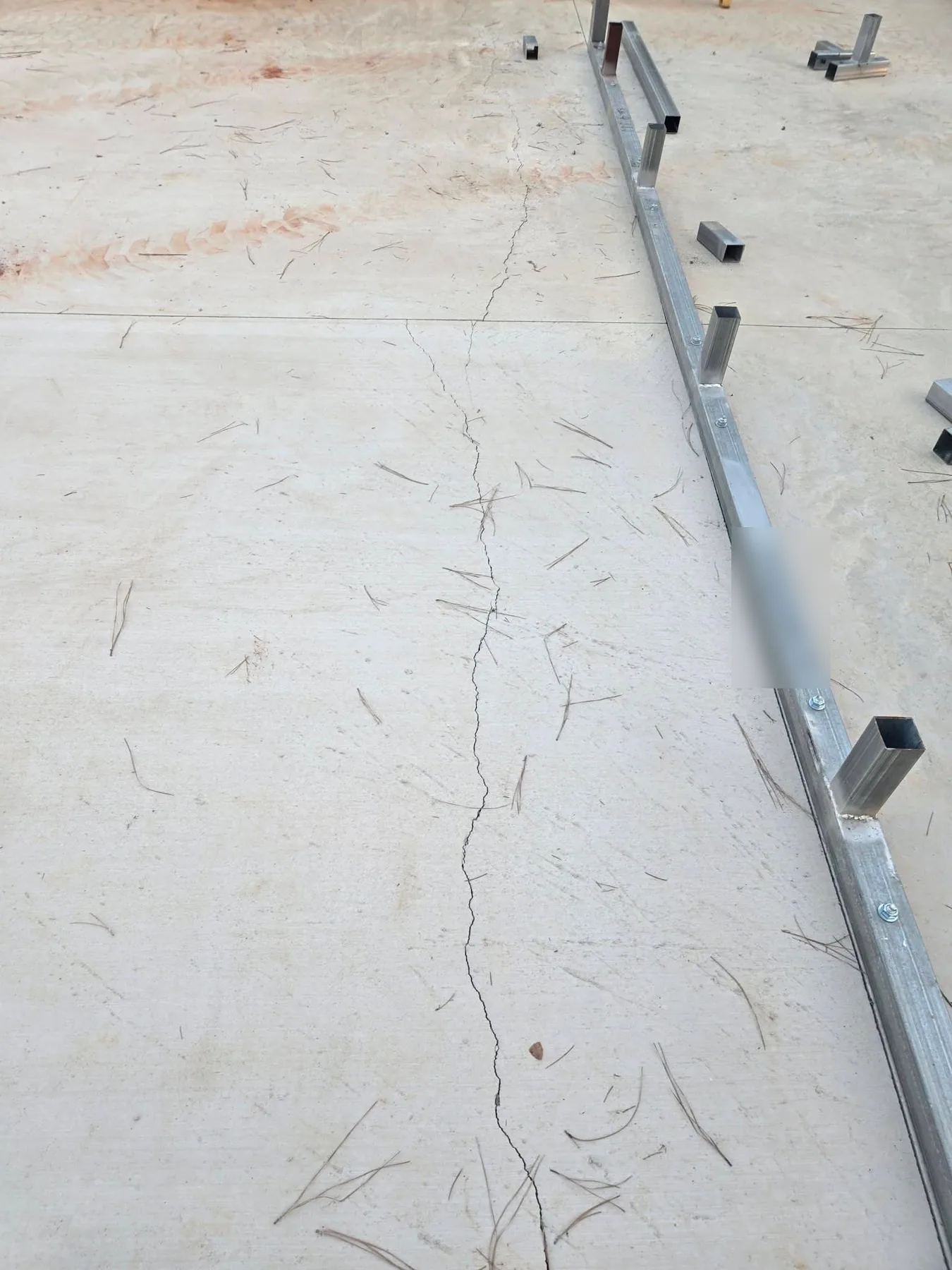
My project record
I am not an engineer. What follows is what I learned trying to understand the crack in photo P-03, from public references and from the people I asked. Where a judgment needs an engineer, I say so.
Why control joints exist
Concrete shrinks as it cures and will crack somewhere. Control joints are cuts made into the slab, usually within a day of the pour, to create straight weak lines so the shrinkage cracks happen there, hidden in the joint, instead of wandering across the floor. A slab with well-placed joints can still have a hundred cracks; you just never see them.
The kind of crack that raises questions
A hairline crack following a joint is the system working. A crack that runs across a panel and through a joint, as mine does, means the joint did not control it. Common reasons in the references are joints cut too late or too shallow, panels too large for the slab thickness, poor subgrade compaction, or a slab thinner than designed. Which of those applies to mine is exactly what an engineer would be hired to say.
Thickness and strength are the quiet variables
A 6-inch slab tolerates larger joint spacing and heavier loads than a 4-inch one, which is why I paid for 6. If the slab is thinner than specified in places, the joint layout designed for 6 inches is wrong for what was poured. That is why the pre-pour measurement in P-01 and the question of coring matter to the crack question, not just to the price question.
What “no warranty” does and does not settle
L&G’s concrete information sheet has the customer acknowledge that there is no warranty of any kind on the slab and that cracks are bound to happen. In my reading that is the company’s position on shrinkage cracking. Whether it answers a slab that is thinner or weaker than the contract specifies is a different question, and one for an attorney rather than a sales sheet.
What to do if your new slab cracks
- Photograph it with a tape for scale and something fixed in the frame for location. Date it.
- Measure the width, and whether one side is higher than the other. A vertical offset is a different problem from a hairline.
- Note where it is relative to the control joints and the columns.
- Write to the company the same day, with the photos.
- If the crack is wide, offset, or growing, get a concrete testing lab or structural engineer to look. Cores will answer thickness and strength at the same time.
Why a customer wrote this
In February 2026 I signed a $98,750 contract with L&G Building & Concrete of Asheboro, North Carolina. By September I had a cracked slab, damaged plumbing and half a steel frame. This site documents it, with the contract, photos, texts and public records. The resources exist so the next buyer does not need to learn the same things the same way.
General information from one customer’s experience and research. Not legal, engineering or financial advice.